Educational reform is best understood as a process rather than an event, requiring sustained interaction between policy, implementation and professional learning. Since 2021, I have contributed to a collaborative reform project involving the British Council and the Ministries of Higher Education and Scientific Research in Federal Iraq and the Kurdistan Region that aims to strengthen pre-service English teacher education nationally. The timeline below summarises the main stages of this five-year programme of work. In a three-part blog, I will describe the work completed (Parts 1 and 2) and (in Part 3) reflect on lessons learned for the reform of pre-service English teacher education programmes.
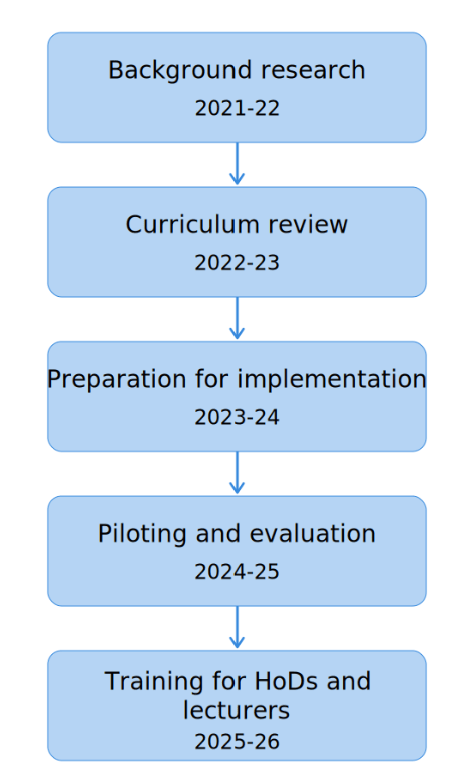
The project began with a large-scale study of English language teaching and learning in Iraq. This examined English language teaching (ELT) across schools, universities, and non-formal educational settings and identified several areas of ELT where reform would support improved secondary school English learning outcomes. One of the report’s central recommendations was that the preparation of pre-service English teachers should be updated, to include a stronger focus on the development of English teaching skills, alongside the existing emphasis on knowledge of language, literature, linguistics and broader educational fields such as psychology.
These findings prompted a major curriculum reform initiative. In 2022-23, working groups involving local experts reviewed existing College English pre-service programmes and developed updated curricula designed to align more closely with contemporary understandings of language learning, teaching methodology, assessment, and teacher competence. To make local buy-in more likely, the goal of the review was not a radical overhaul of the existing curricula but meaningful enhancements to the focus and number of ELT courses.
Following formal approval of the updated curricula, pilot colleges were identified and in 2023-24 their first-year lecturers and department heads (HoDs) received remote and face-to-face support to prepare for implementation. This include work on course design, writing course descriptions and designing sessions. In 2024-25 Year 1 of the updated curricula were piloted in five universities across Iraq and were evaluated using evidence from session observations, interviews with lecturers and HoDs, student feedback, and course documentation. The evaluation found that the revised programmes had been implemented as planned and well-received by staff and students. Areas where further support for curriculum reform were needed were also identified, especially in relation to continuing support for the development of lecturers’ pedagogical skills.
As a result, in 2025-26, the project provided more intensive training for larger groups of HoDs and lecturers. This reflected the view that simply changing the content of pre-service programmes would not automatically improve programme quality or the competence of graduates. It was also necessary to support changes in the design, delivery and assessment of learning. The next phase of the project therefore focused on developing the pedagogical knowledge and skills of College English lecturers. This work and its outcomes will be the focus of Part 2 of this series.
Thank you for sharing. This is very interesting and important and it resonates with what we need in Sudan in our teacher training colleges
Looking forward to part 2
Thanks Amna. What areas of teacher training in Sudan do you feel should be the focus of reform?