Last weekend, I spoke about collaborative professional development at an ELT conference organised by Yeditepe University. My session focused on a key question: when does teacher collaboration actually lead to professional learning? Click on the thumbnail below for an infographic of the talk.
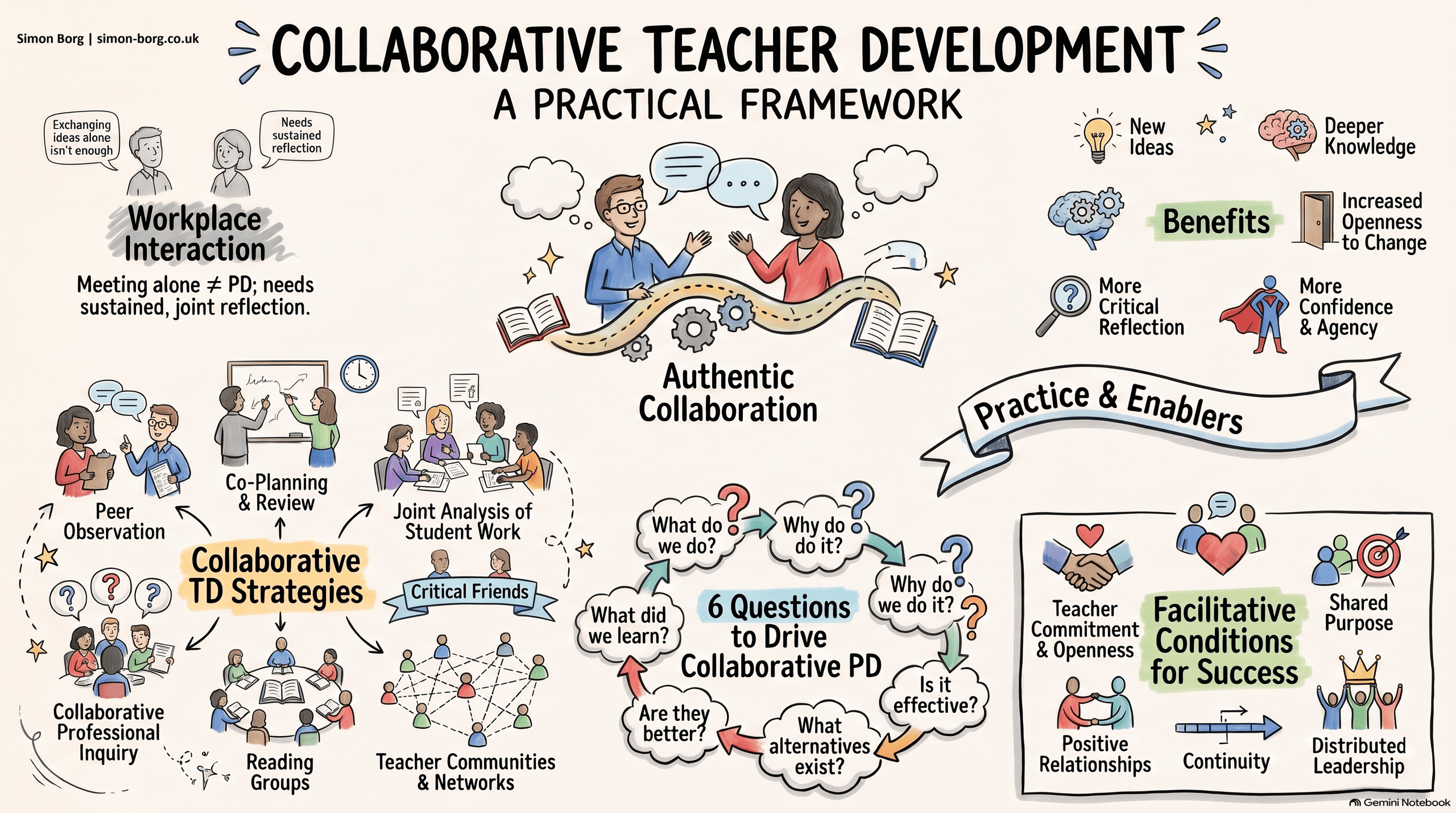
My key message was this: Collaboration is widely recognised as vital to teacher development. However, simply bringing teachers together to meet, talk and share does not guarantee professional growth. Growth occurs only when those interactions activate processes that stimulate learning.
Meeting, talking and exchanging ideas do not necessarily lead to professional development.
So what turns collaborative activity into meaningful professional learning? Three elements matter: the strategies teachers use, the learning processes those strategies activate and the conditions that sustain productive engagement.
Teachers can use many strategies for collaborative PD, as the infographic above illustrates. These activities create opportunities for professional learning and can offer benefits such as:
- deeper professional knowledge
- new ideas from colleagues and external sources
- more critical reflection
- greater openness to change
- increased confidence and agency.
However, whether collaborative PD changes teachers’ beliefs, knowledge and practice depends less on the activity itself than on the depth of engagement it generates. Peer observation, for example, creates a learning opportunity, but this is realised only when teachers use collaboration to examine evidence, question assumptions and consider alternatives. Effective collaborative PD, then, will engage teachers in the following:
- articulating practice and reasoning (what do we do and why?)
- examining effectiveness (how effective are we?)
- questioning practices and assumptions (are our choices justified?)
- examining new ideas (what alternatives exist?)
- trying and evaluating alternative practices (do these alternatives enhance student learning?)
Meaningful engagement with these questions requires teachers to work jointly and reflect critically. A shared purpose, positive relationships, commitment and openness create the conditions in which this work can be honest, challenging and productive.
Continuity is also critical. Collaborative PD cannot be a one-off or episodic event because teachers need repeated opportunities to examine practice, try alternatives, review evidence and refine their thinking over time.
We can therefore move beyond a simple definition of collaborative PD as teachers working together to develop professionally:
Collaborative PD is sustained, purposeful professional learning in which teachers engage jointly and reciprocally with ideas, evidence and practice in ways that stimulate reflection, challenge existing thinking and support changes in professional knowledge and practice.
To get started with collaborative PD, you can:
- find colleagues who are interested in learning together and from one another
- discuss your needs and identify a shared focus
- agree on how you will work together
- examine practice, evidence and alternatives
- try something new and evaluate it
- continue the process over time.
The key question, then, is not simply whether teachers are meeting and interacting, but what their collaboration enables them to examine, question, try and learn over time. When collaborative PD combines purposeful activity, deep engagement and supportive conditions, collegial interactions have a much greater chance of producing meaningful change in professional knowledge and practice.
Further Reading
Christensen, A. A., & Jerrim, J. (2025). Professional learning communities and teacher outcomes: A cross-national analysis. Teaching and Teacher Education, 156, 104920. https://doi.org/10.1016/j.tate.2024.104920
de Jong, L., Meirink, J., & Admiraal, W. (2022). School-based collaboration as a learning context for teachers: A systematic review. International Journal of Educational Research, 112, 101927. https://doi.org/10.1016/j.ijer.2022.101927
Doğan, S., & Adams, A. (2018). Effect of professional learning communities on teachers and students: Reporting updated results and raising questions about research design. School Effectiveness and School Improvement, 29(4), 634–659. https://doi.org/10.1080/09243453.2018.1500921
Hargreaves, A., & O’Connor, M. T. (2018). Collaborative professionalism: When teaching together means learning for all. Corwin.
Vangrieken, K., Dochy, F., Raes, E., & Kyndt, E. (2015). Teacher collaboration: A systematic review. Educational Research Review, 15, 17–40. https://doi.org/10.1016/j.edurev.2015.04.002