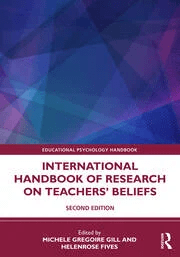
Research on teachers’ beliefs remains one of the most active areas of educational inquiry. Across a wide range of subjects and educational settings, researchers continue to explore what teachers believe about teaching, learning, assessment, motivation, technology and curriculum. This sustained interest reflects an enduring assumption: teachers’ beliefs influence how they make sense of their work and the decisions they make in classrooms every day. The recent publication of the second edition of the International Handbook of Research on Teachers’ Beliefs is a reminder of the vitality and ongoing relevance of this field.
In English language teaching (ELT), interest in teachers’ beliefs has grown substantially over the last 30 years. Since the emergence of language teacher cognition as a recognised field of study in the 1990s, teachers’ beliefs have featured prominently in research on language education. Studies have examined what teachers believe about grammar teaching, corrective feedback, assessment, multilingualism, learner autonomy, teacher development and many other aspects of classroom practice. The result is a rich and diverse body of work that continues to expand internationally.
Surprisingly, the first edition of the international handbook, published in 2014, did not include a chapter on ELT. When I was invited to review the proposal for the second edition, I pointed out this omission and was subsequently invited to address it myself. The result is a chapter in the new edition of the handbook called Teachers’ Beliefs in English Language Teaching.
This chapter reviews research on teachers’ beliefs in ELT published between 2018 and 2024 and considers what it reveals about the current state of this long-established field. Drawing on an analysis of 266 publications and a detailed examination of 30 studies, it explores the geographical distribution, topics, participants, conceptualisations and methodologies that characterise recent work. The review shows that research on teachers’ beliefs remains a productive area of inquiry, with particular attention to issues such as corrective feedback, assessment and writing instruction. At the same time, the chapter argues that much of this research continues to rely on familiar rationales, methods and research questions, especially comparisons between teachers’ stated beliefs and their practices. It concludes by calling for more theoretically informed, context-sensitive and educationally purposeful (as I argued for in an earlier blog) research that seeks to understand teachers’ work in relation to broader professional, institutional and socio-cultural influences.
Dear prof Borg,
I found this handbook very valuable. Is it possible to read it on line or to buy it.
I am currently interested in conducting research on Teacher’s beliefs about using Artificial intelligence (AI) to enhance student’s writing skills in EFL classrooms. Given your expertise in teachers believe, I believe this would be a timely and meaningful area of research. I would be honoured if you would consider collaborating with me on this project
Thanks Saada. The Handbook will be available to purchase online (and maybe even separate chapters too) but for a project in ELT, a good starting point might be a free report such as this one from the British Council: Artificial intelligence and English language teaching: Preparing for the future. https://www.teachingenglish.org.uk/sites/teacheng/files/2024-08/AI_and_ELT_Jul_2024.pdf